Paper Wasp Nest Removal in Philadelphia
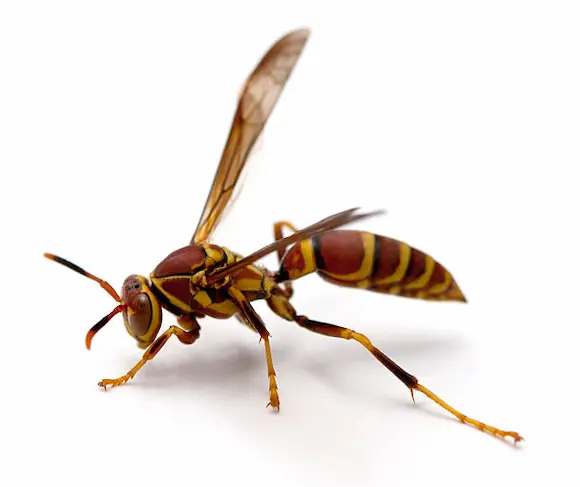
Protect your home from yellow jacket infestation by learning how to identify and distinguish them from bees and other wasps.
If you see a yellow jacket nest near your home or backyard, do not approach it. It is best to contact a trained pest control professional. Keystone Pest Pros are experts in identifying and treating different types of yellow jackets and wasps in Philadelphia. We will provide you with the best solution to suit your specific needs. Call Keystone Pest Pros at (845) 583-8391) for professional yellow jacket nest removal in Philadelphia and surrounding areas.
Paper Wasp VS Yellow Jacket: How to Tell them Apart
Appearance: Compared to yellowjackets, paper wasps are slender and elongated. have orange-colored antennae as well as orange-tinted wings. Some species of paper wasps have reddish-brown stripes instead of yellow.
Size: 0.75 - 1 inch. They are larger but slimmer than a yellow jacket.
Wings: Smoky and semi-translucent.
Body hair: Like yellowjackets, they have minimal body hair.
The dangling legs in flight are one of the fastest visual cues for distinguishing paper wasps from yellow jackets in the air.
Paper wasps are considerably less aggressive than yellow jackets. They will, however, defend the nest if you get too close or make sudden movements, but they rarely pursue a threat the way yellow jackets do. That being said, they are still a threat to your home, especially if you have children or pets.
What Attracts Paper Wasps?
Paper wasps are predators and scavengers, and their diet shifts with the colony's needs throughout the season. During spring and early summer, paper wasps hunt insects like caterpillars, beetles, and flies. They chew these insects into a nutritious protein paste and feed it to larvae inside the nest. This predatory behavior actually makes paper wasps useful as they they suppress populations of garden and crop pests. During the late summer, the colony matures and grows in numbers. Workers shift from eating insects to focusing on sweets like nectar, fruit, tree sap, sugar, soda, etc. During this time, paper wasps become a real issue especially at outdoor picnics and around garbage.
What Does a Paper Wasp Nest Look Like?
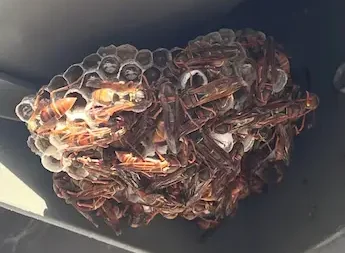
The paper wasp nest is made of a papery material made from wood. The females chew on dead trees and fence posts, then mix the wood with saliva to form a special paste that acts as a building block for their nest. Paper wasp nests are gray or tan with hexagonal cells (6 sided). The cells are fully exposed.
This is the fastest way to identify paper wasps: If the individual cells are visible, it's a paper wasp nest. If they are not, it could be a yellow jacket or bald-faced hornet nest. A mature paper wasp nest may have 20 to 30 adults. This is a much smaller number than yellow jacket colonies, which can reach several THOUSAND adults.
Common nesting sites in Philadelphia:
- Under roof eaves
- Behind window shutters
- Inside porch lights
- Inside door frames and hollow fence posts
We advise you thoroughly inspection your backyard during spring, as this is when queens start building nests. By April, a paper wasp is the size of a quarter, but by July, it can reach the size of a basketball, housing 30+ adult wasps.
The Life Cycle of a Paper Wasp
Spring: A fertilized queen emerges from her winter hibernation when the weather warm up. She selects a nest site and lays the first eggs, raising the first generation of wasps on her own. Sometimes, the queen is accompanied by her sister, who helps in building a nest. The sister can become the next queen is the founder queen dies or loses her way. Occasionally, the backup queen dominates the original queen and takes over the nest. This kind of social complexity is unique among paper wasps.
Summer: Workers take over the construction of the nest construction and start foraging for food and supplies to sustain the colony. The colony grows steadily, with the queen focused entirely on egg production.
Late Summer/Fall: Queens stop laying eggs and the colony begins to decline. In the fall, the female offspring seek overwintering sites. The workers and males die with the first hard frost. The nest is not reused, but the wasps leave behind pheromones that attract new queens the following spring.
Winter: The entire colony dies. Only the fertilized new queens survive. They hibernating through winter. Each surviving queen is the sole representative of that colony going into the next season.
How to Eliminate a Paper Wasp Nest?
Locating the nest early gives you the most options. If you found a small nest in April or May, it can sometimes be treated and knocked down safely with a long-range wasp spray applied at night when the queen has returned to its nest.
1. Treat at night: Paper wasps return to the nest after dark. Nighttime treatment reaches the maximum number of workers, including the queen.
2. Use a wasp-specific aerosol with a jet spray: Stand at a safe distance, aim for the nest attachment point and the cells, and apply thoroughly. Retreat immediately.
3. Wait 24 hours before removal: Attempting to knock the nest down immediately after treatment will result in surviving wasps attacking you.
4. Remove the nest completely. A dead nest leaves pheromone trails that will draw a new queen to the same location the following spring. Nests inside fixtures, behind shutters, or in enclosed spaces like light housings are not suitable for DIY treatments. Confined spaces with limited escape room are where most amateur paper wasp removal attempts go wrong.
For established summer colonies, we recommend you consult a professional wasp exterminator before treating the wasp nest yourself.
Protect your Home from Wasps...
If you've got an active yellow jacket nest in your garden, it is best to let a professional handle it. Do not put yourself or others in danger.
At Keystone Pest Pros, we locate the nest entrance, apply professional-grade treatment directly to the colony, remove the nest structure, and seal entry points to prevent re-infestation the following season. We handle ground nests, wall void infestations, and aerial nests throughout Philadelphia and surrounding neighborhoods.
Frequently Asked Questions
Still have questions? Call us now and speak with a Philadelphia wasp exterminator.
Looking for other pest control services?
We also offer complete pest control solutions for a variety of infestations. Explore our other services below: